MSc EPFL · Embedded Systems & Edge AI

From idea to working prototype, fast.

I build small proofs of concept on real hardware: sensors, firmware, custom PCBs and machine learning that runs on the device. Kept deliberately small, so you find out early whether an idea works.

§ 01 · Approach

Small scope. Working hardware. Clear answer.

  1. 01

    Scope

    We pin down the one question the prototype has to answer, and leave out everything else.

  2. 02

    Build

    Hardware, firmware and models built quickly, on dev kits or custom boards, whichever is faster.

  3. 03

    Measure

    A working demo with measured results, so the next decision is based on data rather than guesses.

§ 02 · Projects

Prototypes I have built

Master's thesis EPFL · CVLab, in collaboration with Logitech April 2026

Gesture Detection with Accelerometer

Illustrations of the six mouse gestures: flick right, flick left, shake, flick up, roll right, roll left
The six intentional gestures the model recognises.
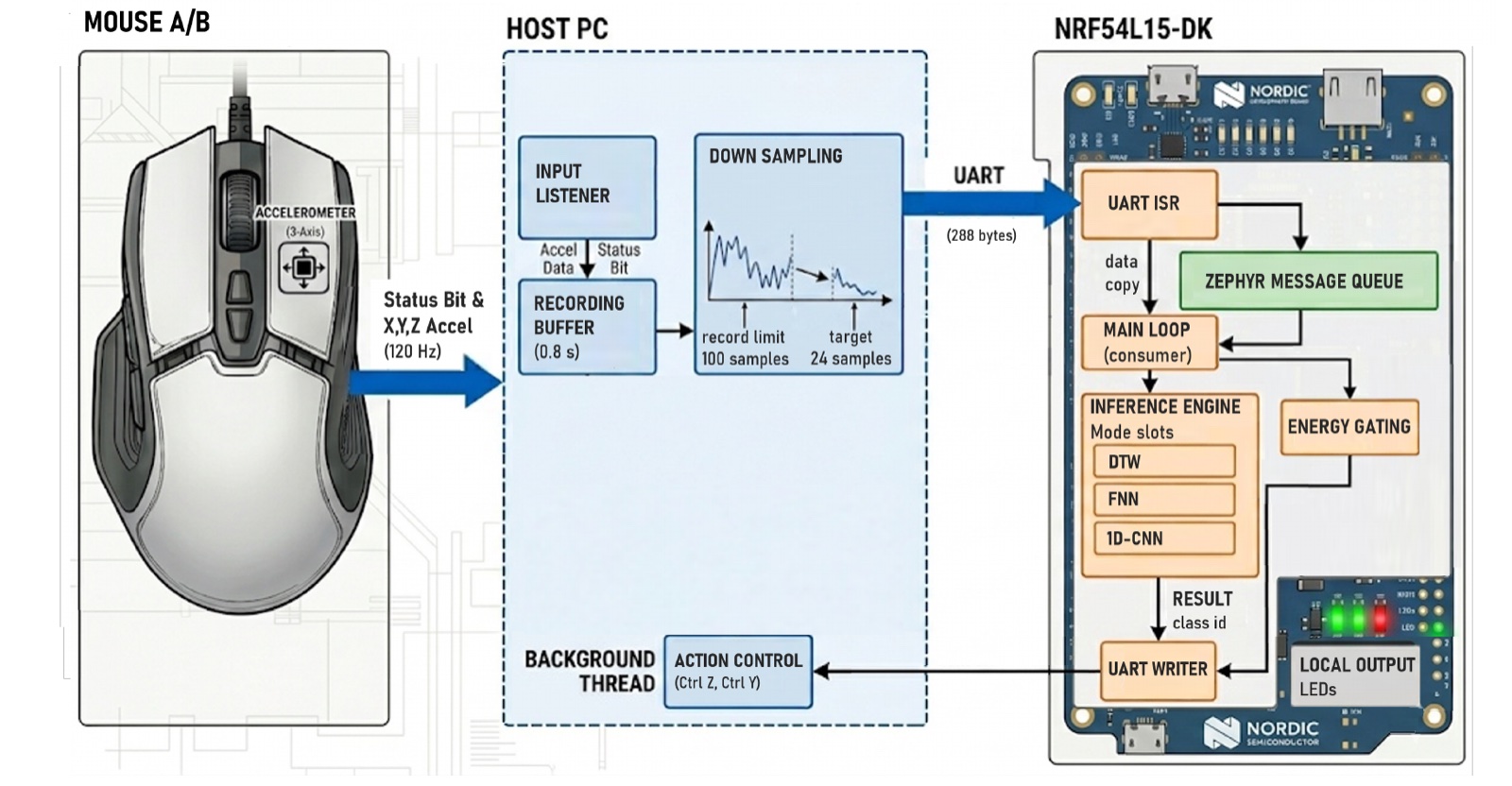
System diagram: accelerometer data from the mouse goes to a host PC for buffering and downsampling, then over UART to the nRF54L15-DK, which runs DTW, FNN or 1D-CNN inference and returns the class
Prototype architecture: mouse accelerometer → host PC → inference on the nRF54L15-DK.

Can a computer mouse recognise gestures using only its built-in 3-axis accelerometer? This thesis explores gesture recognition as a way to trigger shortcuts on productivity mice without additional hardware. It combines real data collection with a synthetic data pipeline built on Unity3D and the Captury Live motion-capture system, which models biomechanical diversity, sensor placement and device geometry. A dedicated "Null" class separates intentional gestures from routine mouse repositioning.

Three classifiers — 1D-CNN, feed-forward network and Dynamic Time Warping — were trained, quantized and deployed on the Nordic nRF54L15-DK.

0.91
Macro F1, 12-class 1D-CNN
2.70 ms
CNN inference on nRF54L15
4.9 KB
8-bit quantized CNN
0.24 KB
"Two-Pass" DTW, 0.32 ms
  • TinyML
  • 1D-CNN
  • DTW / DBA
  • Quantization
  • nRF54L15
  • Unity3D
  • Motion capture
  • Python
  • C
Bachelor's thesis HE-Arc · for ORS Kart Racing August 2022

Digital Slot Car Controller

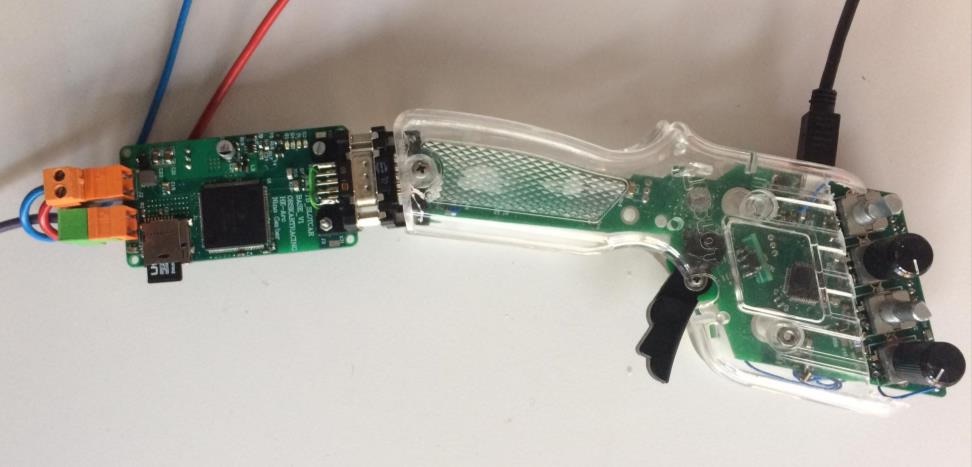
Prototype: the base board with SD card connected to the transparent hand controller with trigger and rotary buttons
The finished prototype: base board (left) and hand controller.
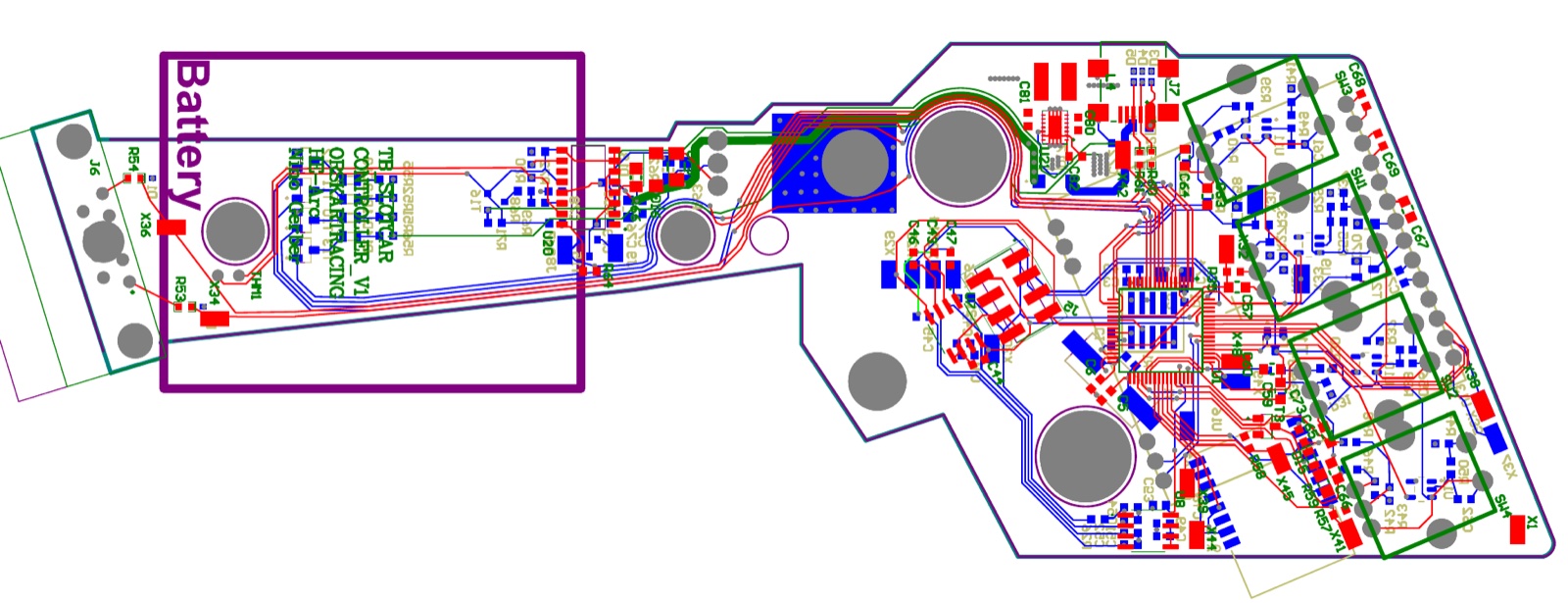
PCB layout of the controller board, shaped to fit inside the controller casing, with the battery area marked
Controller PCB layout, shaped to fit the existing casing.

A prototype slot car controller built around two custom PCBs. The handheld controller reads a friction-free magnetic trigger and four rotary encoders, shows speed and settings on an OLED display, and runs on a USB-rechargeable battery. The base drives the car's DC motor through an H-bridge and talks to the controller by cable or Bluetooth Low Energy.

The work covered component research and selection, schematics, PCB layout, firmware on NXP Kinetis microcontrollers, and testing of the trigger, transmission and motor output.

2
custom PCBs: controller and base
232
distinct trigger positions, magnetic sensor
≤ 15°
magnetic vs mechanical angle deviation
  • PCB design
  • NXP Kinetis
  • C
  • H-bridge
  • BLE
  • Magnetic sensing
  • Power supply

2022 · HE-Arc

Autonomous line-following robot

A robot on the NXP KL46 that follows a track, avoids obstacles and reacts to impacts, built on FreeRTOS with a layered architecture of interfaces, modules and managers. Drivers for the MPU-9250 inertial unit and Bluetooth link were part of the work.

  • FreeRTOS
  • NXP KL46
  • C
  • IMU
  • Bluetooth
  • I²C / SPI / UART

2021 · HE-Arc

DCF77 time-signal decoder IP

A fully synchronous FPGA IP core that decodes the DCF77 atomic-clock time signal, stores the time data in memory-mapped registers and raises an interrupt on each complete frame. It plugs into the PicoBlaze soft-core and has a configurable clock prescaler.

  • VHDL
  • FPGA
  • Vivado
  • PicoBlaze
  • Digital design

2022 · HE-Arc

NFC tag reading and peer-to-peer link

Team project with an NFC module on an Arduino Uno over I²C: reading and writing NFC tags, then peer-to-peer communication between two boards. Also tested on a Raspberry Pi Pico, with a user guide documenting the setup.

  • NFC
  • Arduino
  • I²C
  • Raspberry Pi Pico
  • C++

§ 03 · Contact · Get in touch

Got an idea? Let's build the first version.

Tell me what you want to test. I'll tell you honestly whether a quick proof of concept makes sense and what it would take. If I'm not the right fit, I'll say so.

NG · 01

Nino Gerber

Embedded systems & edge AI · Switzerland

Send a message · Reply by email